Tracking

Measurement built around the lead, designed to remain useful when consent limits what the browser can report. The architecture and running cost follow the measured need.
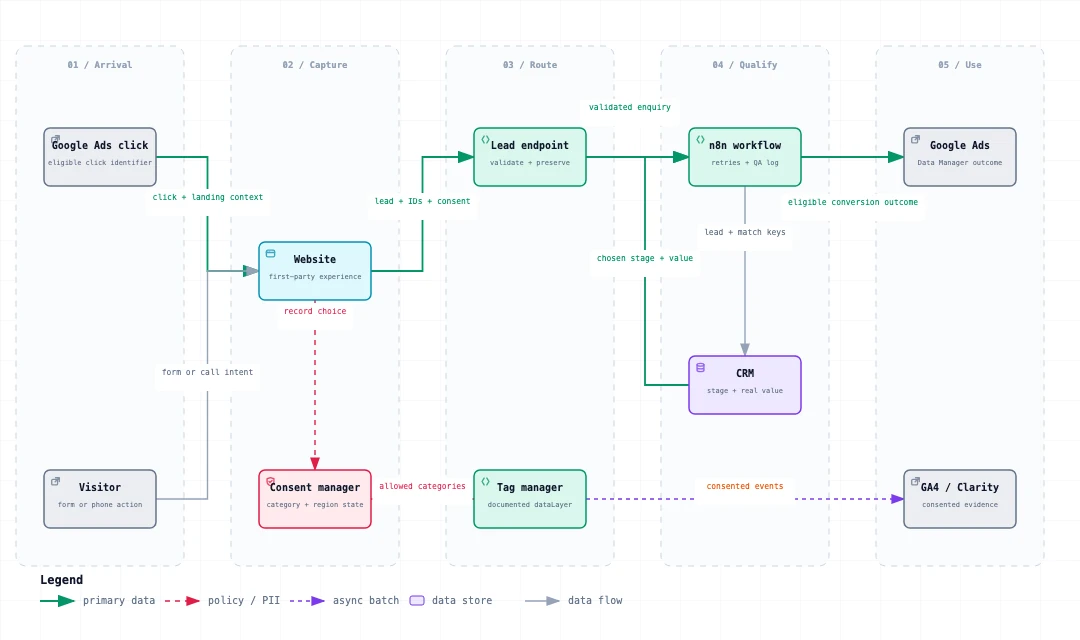
The approach
For ecommerce, we start with a documented purchase event and verified value, currency, transaction ID, refunds and consent state. Enhanced conversions and server-side tagging are added only where eligibility, consent and a measured benefit justify them. A plugin is acceptable when its output is tested rather than trusted by name.
Lead generation is where the effort goes, because the outcome that matters happens off the site.
What we build for lead gen
Microsoft Clarity for consented behaviour evidence. Its session recordings and heatmaps can reveal that a widget obscures a button or that users stop at a field. They suggest where to investigate; they do not prove a visitor's motive. Masking and retention settings are checked as part of the implementation.
n8n for controlled workflows where it fits. A same-origin form endpoint can hand an enquiry to n8n, preserve eligible click identifiers and consent state, write to the CRM, and send an eligible conversion outcome through Google Ads Data Manager. Each handoff has retries, access controls and a QA record; a webhook does not remove the need to maintain field mappings or provider APIs.
Consent Mode is wired to the consent-management platform and tested by category and region. Consent Mode communicates consent state to Google tags; it does not create consent or replace a compliant banner. Platform and legal requirements still need to be checked for the sites and countries involved.
GTM stays for what it is good at: GA4, the odd third-party tag, and the ecommerce side. We write a measurement plan and a dataLayer spec so the next developer knows what fires and why.
What you get
A measurement plan. The dataLayer spec. Consent configured and tested. The n8n lead capture workflow. A QA sheet showing every conversion firing once, with the right value, in the right place.
Free first check
The Google Ads Signal Plan scans up to two public pages, inspects available published Google Tag Manager code and records a fresh pre-consent browser trace for visible tags, forms, telephone links and consent signals. It separates that public evidence from the consent-interaction and account checks that still need access. It is free and does not require an email address.
Sources checked
Partners
CookiePal.
Related: Clarity and n8n instead of server-side tracking · CRM feedback loop
FAQ
Why not server-side tracking for everything?
Server-side tagging and a lead-capture webhook solve different problems. For many lead-generation projects the first priority is preserving the enquiry and later CRM outcome. We add server-side GTM only where a measured need, consent design and maintenance case justify it.
We had a cookie banner and turned it off. It was ugly.
For UK and EU audiences, non-essential analytics and advertising storage normally needs an appropriate consent route. We make the controls clear, test them and keep necessary functions separate from optional measurement.
Do you still do GA4?
Yes. We have worked in web analytics since 2004 and have run GA4 since it launched, including the Universal Analytics migration by hand across multiple properties.