In defence of Manual CPC

In the accounts I manage with a trustworthy outcome signal, routine attempts to improve on Smart Bidding with manual bid changes have generally lost. That is experience from a managed sample, not a universal benchmark.
Manual CPC is still a defensible test in one narrow case: when the keyword is a better label of commercial intent than the conversion data Google receives.
That is not an argument that a person has Google's auction-time context. It is an argument about the objective. Smart Bidding optimises toward the selected outcomes and values available to it. If the real sale is missing and the visible conversions are poor substitutes, the more sophisticated bidder is still learning from the weaker label.
The narrow case
The setup looks like this.
It is a Search campaign with a small group of exact or tightly controlled phrase-match keywords. The business knows those searches usually express a real need. The budget is fixed. The sale happens on the phone, in a branch, through a quotation process or after several follow-ups. Matching that sale back to the click is incomplete, delayed or sometimes impossible.
There is also a person between the click and the sale who can do useful work. The call handler can diagnose what the customer actually needs, explain the alternative and turn an imperfect enquiry into a customer.
In that situation, Manual CPC is not nostalgia. It is a controlled way to buy known intent while the outcome signal is too thin or distorted to steer an automated bidder.
Google can only optimise the conversion it receives
Google documents Smart Bidding signals including query, device, location, time, browser, operating system and combinations of those signals. On a trustworthy objective, that is a strong information advantage over a static keyword bid.
The problem is not a shortage of auction signals. It is a shortage of truthful outcome labels.
Suppose one duration-based call action receives three calls over its thirty-second threshold. One caller books a valuable job, another wants customer service from a different company, and a third is checking a price. Unless another quality or value signal distinguishes them, all three can be recorded as the same selected conversion action.
Or suppose the CRM contains the real sale, but the call never touched the website, the advertising identity was lost, consent prevents matching, or staff entered the customer without the original click information. The business knows a sale happened. Google does not know which auction produced it.
Smart Bidding does not become stupid in that account. It becomes precise about the wrong or incomplete outcome.
The proper fix is qualified call tracking and a CRM feedback loop. Capture the advertising identity, return qualified and closed outcomes, give them real values and let the bidder learn. But that work is not always available on day one, and in some journeys the match will never be complete enough.
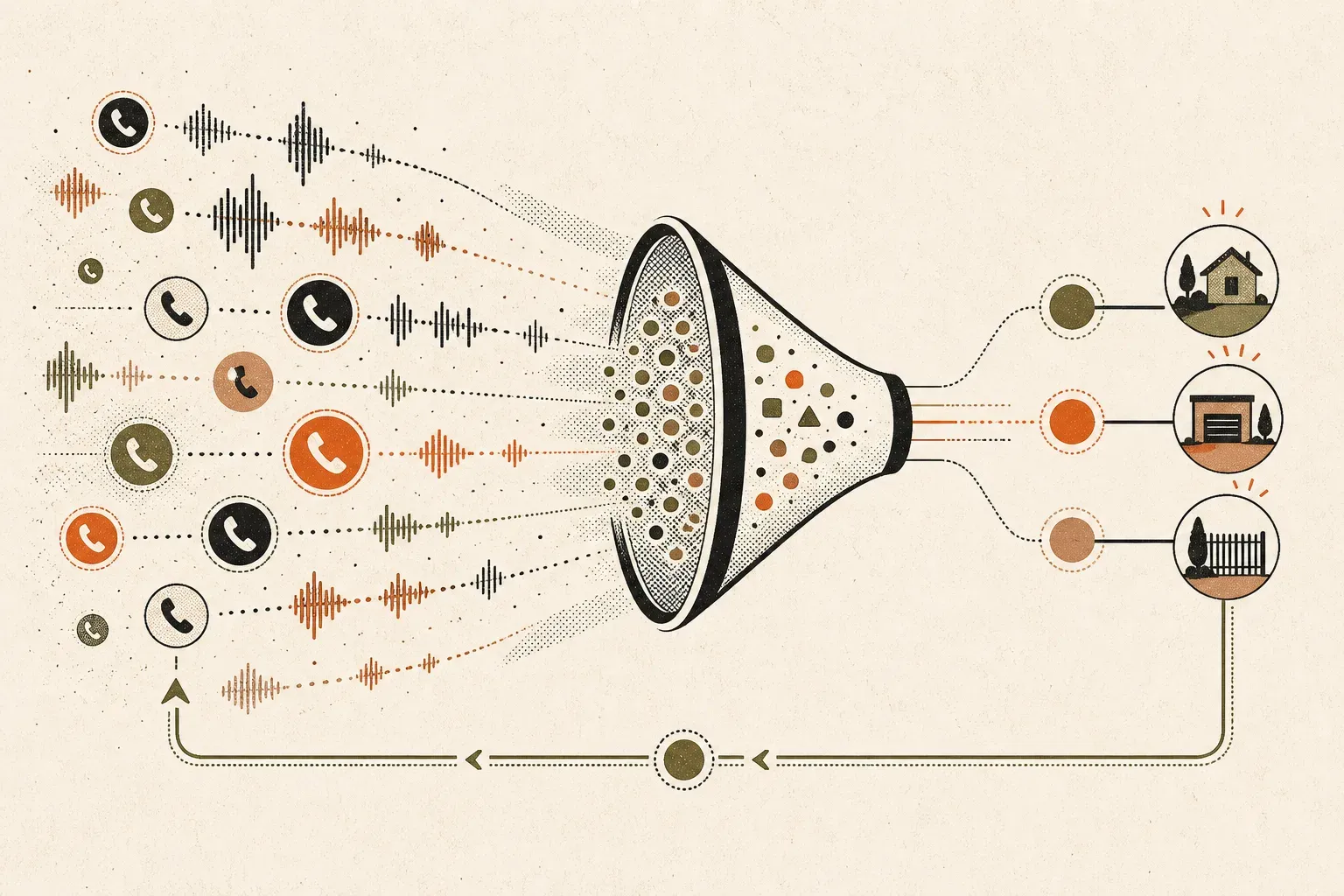
Raw calls are weak labels. Qualification and closed-job outcomes are the evidence Smart Bidding actually needs.
The national-brand spillover case
Take an independent service business competing with the best-known national operator in its category. It could be a windscreen fitter, tyre business, storage company or boiler engineer.
People search the national brand's name for several different reasons. Some are existing customers looking for support. Some need an insurer-appointed provider. Some simply use the famous brand as shorthand for the service. Others have a new problem, want a price and will happily use a credible local alternative.
The search term cannot perfectly separate those people. A good call handler often can.
The honest opening is simple: "We are a different company, but we provide that service locally. Would you like a quote?" A complaint goes nowhere. A customer tied to an existing booking goes nowhere. A price shopper may become a sale.
That mixed traffic can be commercially rational when the clicks are cheap enough. If one sale produces £250 of contribution and one in twenty of those clicks becomes a sale, the expected contribution is £12.50 per click. Buying the traffic at £2 or £3 can work even though nineteen clicks do not sell. The bid is justified by the aggregate economics, not by pretending every enquiry was good.
This is where a blanket negative can be as crude as blind automation. Excluding the national brand removes the complaints, but it also removes the comparison shoppers. Optimising to raw call conversions buys both without distinction. A capped manual bid takes the middle position: buy the ambiguity only at a price the business can afford.
Competitor targeting still has to comply with Google's misrepresentation, trademark and local legal requirements. The ad and landing page should make the advertiser's identity clear and must not imply an affiliation that does not exist. The commercial case is about offering an alternative, not manufacturing confusion.
Why the fixed budget matters
The budget limits the total exposure. The keyword bid limits the price of each attempt.
With Manual CPC, I can assign different base maximum bids to direct, location-qualified and ambiguous competitor keywords. Device, location or other bid adjustments can change the effective maximum, so those modifiers and actual CPCs must be included in the control.
Maximise Clicks solves a different problem. It is asked to buy as many clicks as possible and will naturally prefer cheaper inventory within its cap. Smart Bidding solves a better problem when it has a reliable conversion or value signal. Manual CPC sits between them: it does not know who will buy, but it lets the advertiser encode how much each known category of intent is worth.
I mean plain Manual CPC. Enhanced CPC is no longer the halfway house it once was; Google removed it from Search and Display campaigns in 2025.
Low volume is not enough
There is no magic rule that says an account must run Manual CPC until it reaches thirty conversions. Smart Bidding can borrow query-level learning across an account and use signals beyond the individual keyword. A new or low-volume campaign can still perform well on automation.
Manual CPC becomes defensible only when all of the following are true:
- the campaign is limited to search intent a person can explain and defend;
- the real business outcome is materially missing from Google's data;
- the conversions Google can see are weak or misleading proxies;
- the budget and maximum bids are set from unit economics;
- search terms and call outcomes are reviewed as different things;
- the business can convert at least some of the ambiguity after the click; and
- there is enough aggregate evidence to tell whether the spend produces sales, even if individual sales cannot all be attributed.
Remove those conditions and the argument collapses. Broad targeting, poor search-term control and no sales reconciliation do not become a strategy because the bids are manual. They become an unmanaged click-buying campaign.
Manual CPC is a holding strategy, not a belief system
I would not choose Manual CPC because I enjoy adjusting bids. I would choose it because the business currently knows more about the commercial meaning of a small set of searches than its conversion feed can communicate to Google.
Then I would try to make it unnecessary.
Capture calls from the search results. Preserve click identity through the CRM. Separate complaints and existing customers from new enquiries. Return qualified leads, sales and revenue. Once that signal is representative enough, test Smart Bidding against the manual control and judge both on qualified value, not the conversion column.
The rule is not "manual good, automation bad". It is simpler.
When the outcome signal is trustworthy, trust the bidder. When it is badly incomplete but search intent and economics are knowable, cap the click, cap the budget and let the sales team handle the commercial context that has not been supplied to the ad account.
That is the case for Manual CPC.
Sources checked
- Google Ads: auction-time Smart Bidding signals
- Google Ads: Manual CPC bidding
- Google Ads: Enhanced CPC deprecation
- Google Ads policy: misrepresentation
Qualified call tracking · CRM feedback loop · Budget is the limiter